Prepare for the ABFAS didactic exam with strategies for focused reading, reviewing images, steady pacing, and a study plan built around your weak subjects.
Preparing for the ABFAS didactic exam can feel overwhelming, but your approach can make the process more manageable. Rather than trying to cover everything at once, focus on a plan that helps you understand the format, recognize what each question is testing, and stay steady as you answer. As the saying goes, failing to plan is planning to fail.
Preparation should focus on understanding how the exam works and building a deliberate approach before test day. This guide covers the practical strategies that can help you make confident, well-reasoned decisions throughout the exam.
Where the Didactic Exam Fits in ABFAS Board Qualification
The ABFAS didactic exam is one component of Part I Board Qualification with the American Board of Foot and Ankle Surgery (ABFAS). It is an 80-question, computer-adaptive examination completed in 120 minutes that assesses the clinical knowledge and decision-making required for the Foot Surgery and Reconstructive Rearfoot/Ankle (RRA) Surgery pathways.
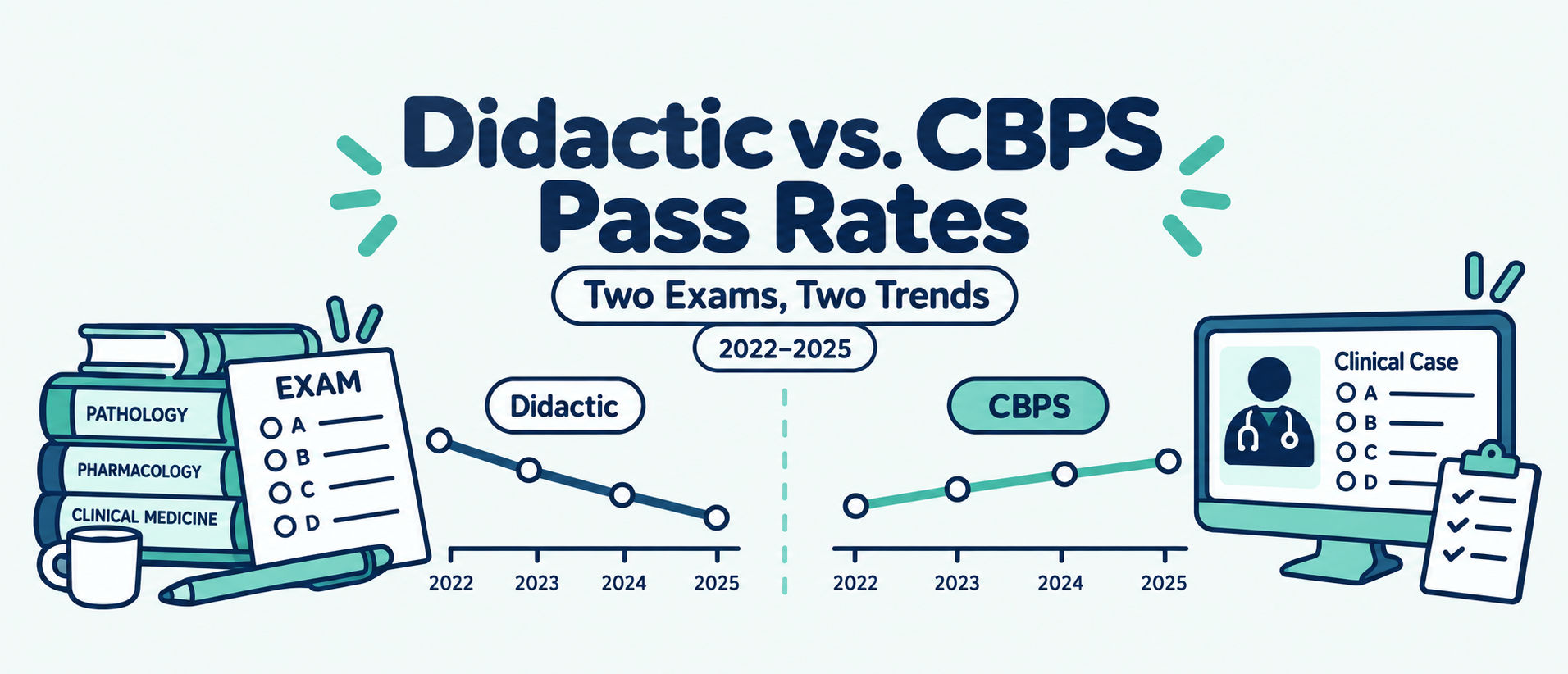
The didactic portion is separate from the computer-based patient simulation (CBPS) examination, which assesses candidates through patient-based cases rather than multiple-choice questions. For eligible final-year residents, a qualifying score on the corresponding In-Training Examination (ITE) may satisfy the related Part I Board Qualification examination requirement, subject to current ABFAS rules and fees. ABFAS Candidate FAQs
If you are a podiatry resident or attending physician preparing for ABFAS board exams, this guide explains how the didactic exam is structured and scored, what to expect on test day, and how it differs from other ABFAS exams. It also covers the study resources, prep methods, test-taking strategies, and common misconceptions that matter most. Understanding the format in advance can help you study more efficiently, make better exam-day decisions, and improve your chances of passing, therefore moving you closer to ABFAS board qualification and certification.
Exam at a glance: 80 questions, 120 minutes, adaptive difficulty, 200 to 800 scale, 500 to pass, and answers lock in.
ABFAS Didactic Exam Structure
How the ABFAS CAT Exam Adapts to Your Answers
The ABFAS computer adaptive testing format selects the next multiple-choice question based on whether your previous response was correct or incorrect. Your job is not to interpret the difficulty of the next question; it is to make the best clinical decision on the question in front of you. As the exam proceeds, the system adjusts question difficulty while establishing your demonstrated ability level. But remember, a difficult question does not mean you are passing, and an easier question does not mean the opposite. Again, your task is to answer the question in front of you as accurately as possible.
Based on actual test takers' observations, the ITE may present questions at a level that corresponds with your residency year, introducing more advanced clinical decision-making as residency progresses. This is not an official ABFAS rule, but it is a useful reminder not to underestimate any exam based on your residency year. Prepare for challenging questions and train yourself to work through difficult clinical decisions so you can approach the exam with greater confidence and apply the practical strategies discussed throughout this guide.
How ABFAS Didactic Exam Scoring Works
The ABFAS didactic exam format uses scaled scores rather than raw percentages. ABFAS reports didactic and new CBPS scores on a 200 to 800 scale, and the minimum passing score is 500. So remember exams are not scored on a curve. The total score reflects your performance across the entire exam, while subject-area scores are reported separately and should be interpreted cautiously because they rely on fewer questions.
ABFAS also states that scores reflect the difficulty of questions answered correctly. You do not need to reverse-engineer the algorithm between questions. Focus on the clinical judgment the question is asking you to demonstrate. ABFAS states that failed exams are automatically rechecked and rescored before results are released.
Four exam questions in a row, each marked Locked, with a crossed-out back arrow: on the ABFAS didactic exam you can move forward but not go back.
You Cannot Go Back After Answering a Question
Once a question is answered, it cannot be revisited. This locked-answer rule means you should read the entire stem, identify the concept being tested, review every available image, compare the choices, and then answer.
Before you submit a response, stay aware of negative wording and all available image tabs. Additional images may require clicking through tabs after the first image. Missing a tab is an avoidable interface error, not a subtle board-style trick.
Understanding the 120-Minute Time Limit
Eighty questions in 120 minutes works out to an average of 90 seconds per question. That is a personal pacing calculation, not an ABFAS rule. Some questions will be resolved quickly; Image-heavy or clinically dense questions may need more time. Your goal is to keep moving without treating every question as though it deserves the same amount of time.
Practical Strategies for the ABFAS Didactic Exam
Start Strong, Then Stay Steady
Step Up Boards recommends a Start Strong approach: Give your early questions calm, deliberate attention rather than rushing to prevent errors. This is a practical strategy, not an ABFAS rule, where the first 15 to 20 questions establish a fixed scoring window or permanent difficulty ceiling.
What this looks like in practice is straightforward: start with the same clinical discipline you will need throughout the exam, read questions carefully, identify the qualifiers, select the best-supported answer, and keep enough pace for the remaining questions. Starting strong does not mean overinvesting. A question rarely becomes clearer because you spend several extra minutes staring at it.
Sample exam question annotated to show three parts: patient context, the qualifier words LEAST likely, and the actual ask about initial management.
Read the Question Stem First
When time pressure starts to build during the examination, use this repeatable sequence:
Identify the actual concept being tested: diagnosis, imaging interpretation, treatment, procedure selection, complication, or next step.
Check for qualifiers such as except, least likely, or not.
Review the clinical details, images, and answer choices.
Choose the answer best supported by the question stem before answering.
This ABFAS didactic exam strategy prevents a common avoidable error: selecting the right answer to the wrong question.
Review Every Available Image Before Answering
For foot and ankle surgery questions, imaging may carry the diagnostic or operative discriminator. Before submitting an answer, confirm that you have viewed each available image and consider whether it changes the diagnosis, procedure, or management choice. Practice this habit while preparing so checking every image becomes automatic on exam day.
Use Elimination, Make an Educated Guess, and Move On
When two answer choices remain plausible, use the process of elimination to rule out the choice that conflicts with the stem, the patient context, or the sequence of care. Then make the most defensible educated guess, submit the answer, and move on.
This is not a suggestion to answer casually. It's a way to avoid spending a disproportionate amount of time on one difficult question while the rest of the exam remains unanswered. In a locked-answer adaptive format, a best-supported answer is better than a stalled decision.
Pacing band, not a timer: fast questions 45 to 60 seconds, typical pace about 90 seconds, image-heavy questions 120 to 150 seconds. Bank time on easy questions to spend on harder ones.
Use a Steady Pace, Not a Rigid Timer
Move efficiently through questions and give appropriate attention to dense clinical stems. Use the 90-second average only as a broad checkpoint. If you repeatedly spend several minutes on individual questions, the decision process needs to become more concise before exam day.
Keep your focus on the clinical problem presented to you. The objective is not to control the difficulty of the next question. It is to answer the current one as accurately as possible.
Four-step method for each question: identify the concept, check the qualifiers, review details and images, then choose the best-supported answer.
Practice One-Way Decision-Making Before Test Day
Your preparation should reflect the mental acumen required on exam day: read, reason, select, and move forward. Use timed tests without backtracking, then review missed questions only after the test is complete. This keeps the two tasks separate: on test day, you make the best decision available; during review, you investigate why it was right or wrong. Want to put this approach into practice? Step Up Boards provides explanations for both the wrong and right answer choices along with supporting citations after completing practice tests.
How to Prepare for the ABFAS Didactic Exam
Start With Official ABFAS Content and Practice Resources
Begin with the current ABFAS content outline for your pathway and review the subject areas and relative weightings. Then use official practice exams to become familiar with question style. ABFAS notes that candidates can take its didactic practice exams repeatedly and receive a report showing their answers, subject areas, subcategories, and explanations. The official practice exams are not computer-adaptive. ABFAS: Didactic Exam Preparation To make your preps feel more like an exam-day exercise, use Step Up Boards.
This applies to both the ABFAS Foot Surgery didactic exam and the ABFAS RRA Surgery didactic exam. A generic review schedule is less useful than a plan built around the content relevant to your pathway.
Step Up Boards performance dashboard shows you exactly which subjects need your focus.
Use Practice Results to Identify Repeated Weak Subjects
Do not overreact to a single missed question. Look for recurring gaps across diagnosis, imaging, procedure selection, perioperative management, complications, or interpretation of the question stem. Your study plan should name the problem precisely enough to guide your next review block.
Review how you performed across repeated question sets rather than drawing a conclusion from one missed question. For example, if you tell yourself, 'I need to study ankle surgery,' the target is still too broad. A focused target identifies the imaging finding, procedure decision, or diagnostic gap you need to revisit.
Instead of guessing what to study next, see the subjects that need more attention. Step Up Boards uses your test results to build a focused daily plan.
Step Up Boards provides explanation for both right and wrong answer choices so you can understand the reasoning.
Review the Reasoning Behind Incorrect Answers
A missed question is only useful if it changes what you review next. High-yield review is not simply reading the correct answer. For each missed question, ask:
What clue in the stem, image, or timeline did I miss?
Why was the correct answer the best answer, and how would the correct answer guide your management of the case?
Why were the distractors less appropriate?
Which clinical concept, source, or subject area needs review?
That process makes ABFAS didactic exam preparation more useful than repeatedly rereading material you already recognize.
Step Up Boards automatically generates a personal reading list based on your missed questions.
Turn missed questions into a targeted study plan
Step Up Boards can help you turn a missed question into a focused next step. Use board-style DPM questions, explanation-linked citations, and source-based reading lists to identify your low-confidence subjects and plan your review around them. That builds a more targeted review with Step Up Boards.
ABFAS CAT Exam Myths That Can Hurt Your Approach
Once you have a workable approach, it also helps to remove the assumptions that can quietly derail it.
Myth: "I Should Intentionally Miss Questions to Get an Easier Exam."
Reality: ABFAS says that intentionally answering incorrectly may result in an easier exam. However, CAT exams are graded on difficulty rather than percentage correct, and ABFAS states that purposely incorrect answers result in a lower score. Answer every question to the best of your ability.
Myth: "One Hard Question Means I Am Passing."
Reality: Adaptive testing typically adjusts question selection as it evaluates demonstrated ability. A single question, or a short run of questions, does not provide a reliable interpretation of your final score.
Quick question
Was this content helpful?
Thanks for the honesty
What was missing?
Got it
Frequently Asked Questions
Can I reschedule an American Board of Foot and Ankle Surgery (ABFAS) exam?
ABFAS allows candidates to reschedule within an exam window, subject to Pearson VUE seat availability. Seats can become more difficult to secure closer to the scheduled date. Before jumping to a decision, refer to the current ABFAS exam dates and registration information and scheduling instructions before making a change.
Each ABFAS exam has dedicated testing dates. Residents may take the In-training Examination (ITE) once each fall, while attending physicians may take the Part I exam during the fall or spring testing period. Third-year residents take the ITE in the fall of their final residency year, and a qualifying score may be used toward Board Qualification under current ABFAS requirements.
What is the passing score for the ABFAS didactic exam?
ABFAS uses scaled scores from 200 to 800, with 500 as the minimum passing score for each didactic exam; exams are not scored on a curve. For Foot Surgery Board Qualification, you must pass the Foot Surgery Didactic and Foot Surgery CBPS. RRA Surgery Board Qualification requires all four components: Foot Surgery Didactic, Foot Surgery CBPS, RRA Surgery Didactic, and RRA Surgery CBPS. For example, passing the Foot Surgery CBPS, RRA Surgery Didactic, and RRA Surgery CBPS is not enough if the Foot Surgery Didactic remains incomplete. Final-year residents who score at least 500 on the corresponding In-training Exam component may use that result toward the related Board Qualification requirement after they pay the applicable fee.
Can test takers intentionally answer questions incorrectly to get an easier test?
No. ABFAS states that intentionally incorrect answers may lead to an easier exam but result in a lower score. Answer every question to the best of your ability. This is not a matter of personal opinion or test-taking folklore. It follows directly from how ABFAS describes adaptive scoring.
What practice resources are available for the ABFAS didactic exam?
ABFAS offers official didactic practice exams. You can also use independent study resources such as Step Up Boards for board-style podiatry questions, explanation-linked citations, and targeted review tools. Step Up Boards just gives podiatrists the quality assistance they need to stay ahead of the ABFAS certification.
Comparison between the ABFAS Didactic and CBPS exams?
The didactic exam uses multiple-choice questions to assess clinical knowledge and treatment decisions relevant to podiatric surgery. In the CBPS exam you work through a patient scenario by collecting and analyzing information, making diagnostic and treatment decisions, and managing the case efficiently. The exam assesses related knowledge, but they require different prep methods. ABFAS Candidate FAQs
Summary
The strongest strategy is not to outguess the CAT. Start focused, read the stem and images carefully, eliminate unsupported options, make the best-supported answer, and keep a steady length pace. Use practice results to identify recurring weak domains, then study the reasoning and references behind missed questions.
For a more structured next study session, Step Up Boards is a helpful tool to practice board-style questions and build your review around the topics that need more attention.
Disclaimer
This article provides independent educational guidance and is not an official ABFAS resource. It does not replace current ABFAS policies, eligibility criteria, exam instructions, or candidate materials. Confirm requirements directly with ABFAS before you register or take an exam.
Dr. Ersta Ferryanto is a board certified podiatric physician and surgeon practicing in the Chicago area. He completed his Doctorate at Des Moines University College of Podiatric Medicine and Surgery in Des Moines, IA, and completed his surgical residency at Ascension Saint Joseph Chicago, where he served as Chief Resident in his final year.
After passing his boards on the first try, he co-founded Step Up Boards to help other DPMs do the same.