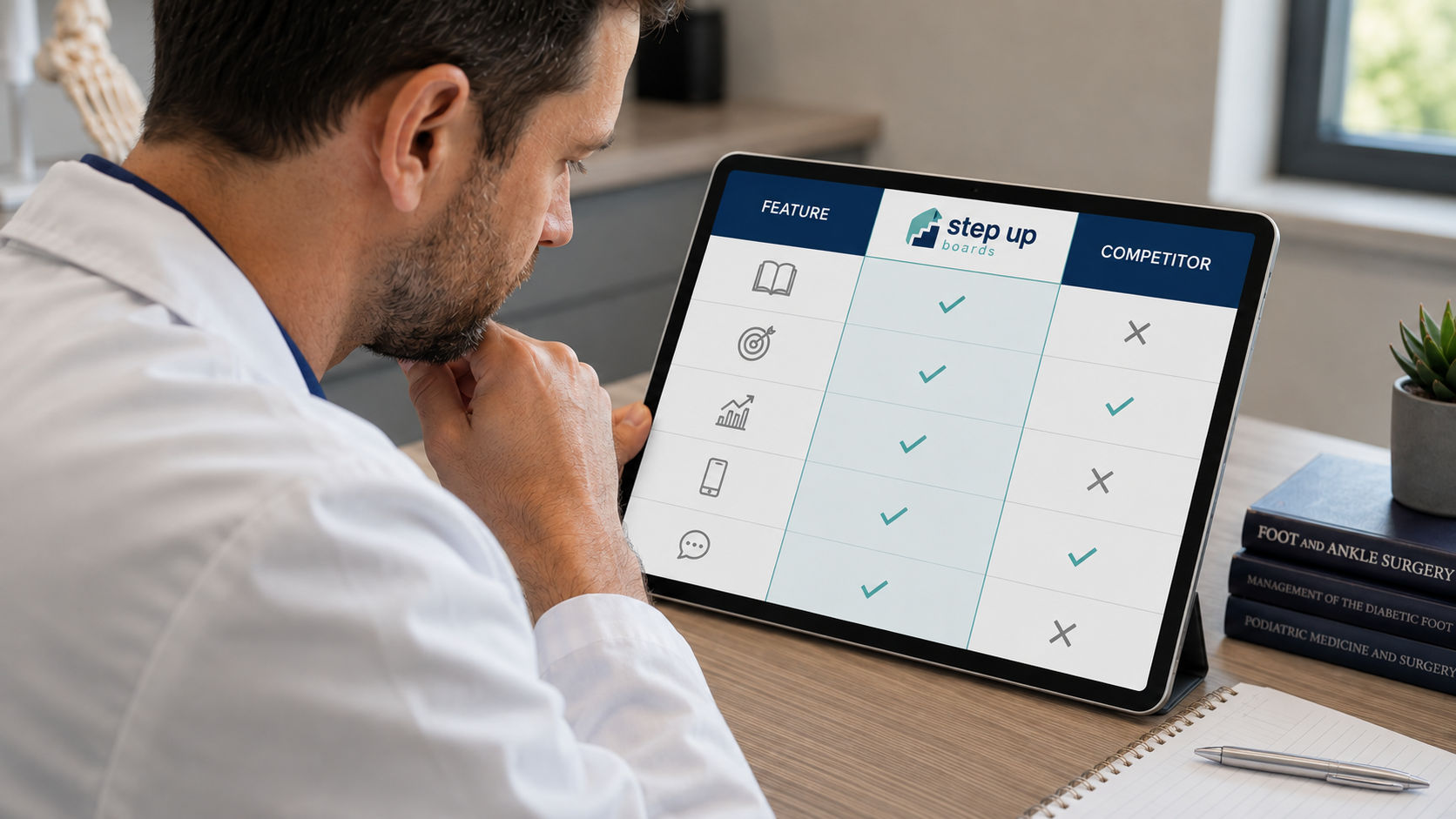
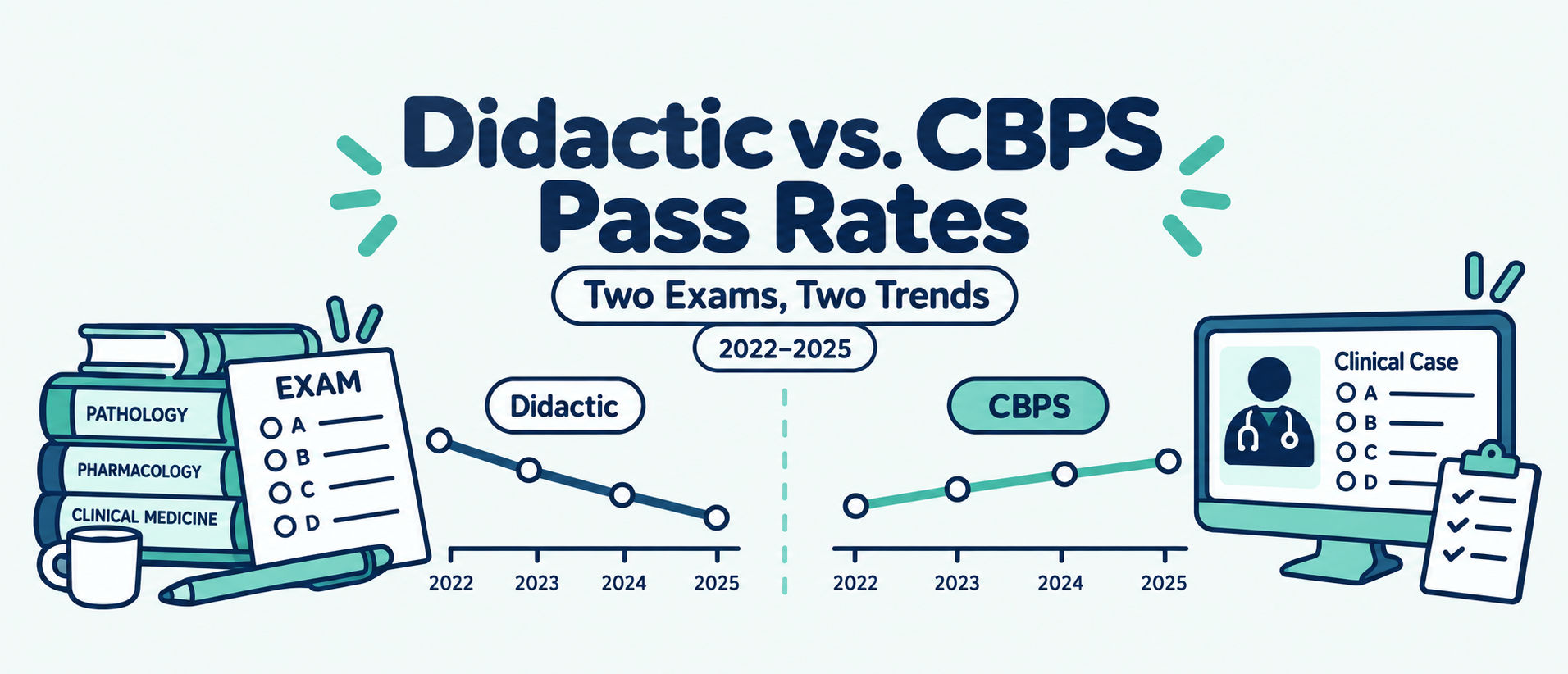
When preparing for test day, you will likely turn first to the official ABFAS didactic practice exam to understand how the exam works and how its questions are presented. However, it should be treated as an introduction to the format rather than a complete reflection of the question quality and difficulty you may encounter on the actual exam. If you are a podiatry resident or a podiatric physician preparing for ABFAS board qualification, you are probably wondering the same things: Was the practice exam enough? How difficult will the actual exam feel? Will you recognize exactly what each question is asking? Will you remember to view every image before submitting an answer you cannot change?
Preparing beyond the practice exam means practicing how you will read, reason, and answer under test-day conditions so you can strengthen clinical reasoning, find weak areas, and improve your chances of passing. This guide explains what the ABFAS didactic practice exam can and cannot tell you, then walks through exam-day procedures, question-review technique, focused study plans for weak subjects, board-prep resource choices, and related ABFAS exam details and FAQs, using up to date ABFAS information and practical strategies developed from the experience of podiatrists preparing for the exam.
What the ABFAS Didactic Practice Exam Can and Cannot Prepare You For
The official practice exam is a useful place to begin. However, you should not assume that the practice questions reflect the quality or difficulty of the questions you may encounter on test day. After answering the practice exam, you can review your answers, see the subject area and subcategory for each question, and read an explanation of the correct answer. You may also take the practice exam multiple times.
What it cannot fully reproduce is the computer-adaptive experience of the real exam. Repeating familiar questions can also make your score feel reassuring without showing how you will handle an unfamiliar patient presentation or several plausible answer choices.
Use the practice exam as an initial assessment of your knowledge. Then broaden your preparation to include challenging practice questions, complete image review, qualifier recognition, and case-based reasoning. The goal is not to dismiss the official resource. It is to help you understand what additional resources will best support your preparation.
What to Confirm Before Your ABFAS Exam Day
Several days before your appointment, confirm the following:
- Exam details: Verify the date, start time, time zone, test-center location, and that you scheduled the correct exam.
- Identification requirements: Check which forms of identification Pearson VUE requires and confirm that the information matches your appointment record.
- Admission instructions: Review the current rules for permitted and prohibited belongings. Use your appointment confirmation and the official website because requirements may change.
- Rescheduling policy: If you need to reschedule, act early. ABFAS currently allows candidates to reschedule within the exam window up to 24 hours before exam day, subject to Pearson VUE seat availability. Seats may become harder to find approximately 30 days before the exam.
- Withdrawal policy: Review this separately because withdrawing from the exam is not the same as rescheduling your appointment.
The day before the exam, complete one final check of your appointment, identification, arrival instructions, route to the testing center, and contact information for reporting a testing problem.
What to Expect During ABFAS Exam-Day Check-In
Arrive at the instructed time and present the required, nonexpired identification. Test takers who bring an expired ID will be turned away. Follow the current admission and security procedures, store prohibited belongings as directed, and listen carefully even if you have taken another board exam at Pearson VUE.
Before beginning, confirm that the computer and exam screen function properly. Report a technical problem immediately instead of trying to work around it. Your attention should be focused on the exam, not wondering whether an image displayed correctly.
How to Approach Questions on the ABFAS Didactic Exam
Review the Complete ABFAS Didactic Question Format
Before answering, review the entire question. This includes the complete stem, every answer choice, clinical details, qualifiers, and all available images. ABFAS specifically advises candidates to pay attention when a question is presented in the negative and to view all available images.
Once a question is answered, you cannot return to it.
Check These Five Points Before Submitting Each Answer

A consistent check before submitting an answer can prevent familiar exam-day errors. Step Up Boards recommends asking:
- What concept is the question testing?
- Is there a negative qualifier?
- Have I viewed every image?
- Trust Your First Instinct: Which answer is best supported by the complete information?
- Am I ready to submit and move forward?
Practice this sequence until it feels familiar rather than like an extra task.
Identify the Exact Concept Being Tested
Recognizing the diagnosis may be only the first step. A stem describing a familiar deformity may ask for the appropriate procedure, a relevant radiographic measurement, the next step in management, or a likely complication. Read the question closely enough to know which of those decisions you are being asked to make.
A correct observation does not produce the correct answer when the question asks about another part of the case.
Recheck Negative Qualifiers
Words such as except, not, least likely, and incorrect reverse what the question is asking. The clinical subject may be familiar, yet one missed qualifier can send your reasoning in the wrong direction.
Locate the qualifier, restate the question, and evaluate each answer choice according to that. Recheck the qualifier before submitting.
View Every Image Before Answering
Do not answer from the first recognizable abnormality. In the didactic portion, images appear directly with the question prompt as small thumbnails that can be expanded with a click. Open and review every AP, lateral, and oblique radiograph provided, along with any clinical photographs or sequential images. Image quality may be limited, so compare each view carefully and determine whether another image changes the diagnosis, classification, or procedure selection.
One view may show the obvious deformity, while another helps separate two reasonable answer choices. Make opening and reviewing every image part of your routine.
Trust Your First Instinct

Your first answer is often based on the clinical details you recognized when you initially read the question. If that choice is supported by your clinical reasoning, trust it and avoid replacing it simply because you feel uncertain before submitting.
Nervousness can make another answer choice seem more appealing even when no new evidence supports it. Return to the qualifier, clinical findings, and images to confirm your reasoning. If these details continue to support your first choice, stay with it.
Change your answer only when you identify a specific detail you missed that clearly supports another choice. Otherwise, trust your first instinct and submit the best supported answer.
Review the Answer Choices to Navigate a Complex Clinical Case
Step Up Boards recommend the strategy of scanning the answer choices briefly before fully analyzing a long, information-dense stem. The choices may show that the question is comparing diagnoses, procedures, classifications, complications, or imaging findings. You can then return to the stem knowing what type of distinction you need to make.
This "Read Backwards" approach is optional and does not replace reading the complete stem. If it causes you to anchor on a familiar choice, return to your usual stem-first approach.
This "Read Backwards" approach is optional and does not replace reading the complete stem. If it causes you to anchor on a familiar choice, return to your usual stem-first approach.
Apply the Step Up Boards "Start Strong" Strategy
Step Up Boards recommends approaching the first 15 to 20 questions with particular care. Use them to establish a deliberate rhythm: read the complete stem, identify the concept being tested, check the qualifier, view every image, and compare all answer choices.
"Start Strong" does not mean spending unlimited time on the opening questions. Maintain a sustainable pace. ABFAS has not published a fixed difficulty ceiling based on the first 15 to 20 questions, so treat this as a practical attention strategy, not an official scoring rule.
"Start Strong" does not mean spending unlimited time on the opening questions. Maintain a sustainable pace. ABFAS has not published a fixed difficulty ceiling based on the first 15 to 20 questions, so treat this as a practical attention strategy, not an official scoring rule.
How to Prepare Beyond the Official ABFAS Practice Exam
Learn From Correct Answers and Incorrect Answer Choices

The number of correct answers gives you a score. The explanation review tells you what to do next. For every missed question, determine whether the problem was a knowledge gap, an overlooked qualifier, incomplete image review, or an unsupported clinical assumption.
Review why each incorrect answer choice is less appropriate. That often reveals a reasoning error that could recur in another form. Supporting citations also direct you to a specific subject for review.
The best online resources, like Step Up Boards, provide explanations for both the correct answer and the incorrect answer choices. This allows you to understand why one answer is best supported, identify the reasoning that led you toward another choice, and determine what you need to review before your next practice test.
Review why each incorrect answer choice is less appropriate. That often reveals a reasoning error that could recur in another form. Supporting citations also direct you to a specific subject for review.
The best online resources, like Step Up Boards, provide explanations for both the correct answer and the incorrect answer choices. This allows you to understand why one answer is best supported, identify the reasoning that led you toward another choice, and determine what you need to review before your next practice test.
Choose a Question Bank That Supports How You Need to Practice
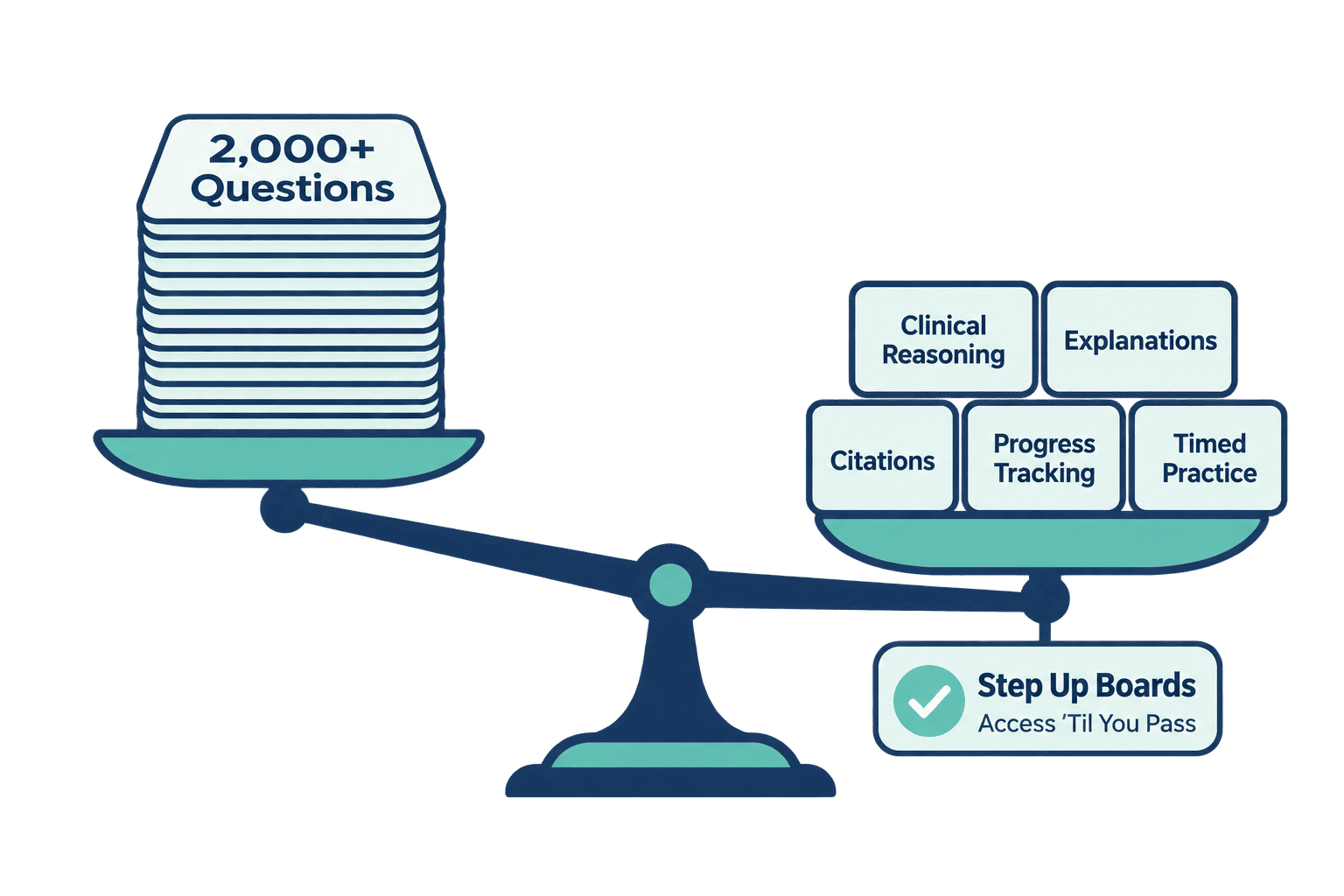
Having access to more than 2,000+ questions does not automatically mean you are receiving better preparation. The questions should challenge your clinical reasoning, reflect a range of difficulty, incorporate relevant imaging, and explain both the correct and incorrect answer choices. A useful board prep provider should also help you practice under timed conditions, identify weak subjects, and find reliable citations for further review.
Look beyond the phrase "100% pass guarantee" and review what the offer actually provides. In many cases, it refers to temporary complimentary access after an unsuccessful attempt, subject to eligibility requirements and an expiration date, rather than a guaranteed outcome. You are preparing to pass, but a dependable board prep provider should also offer clear, continued support if you need more time. Compare the quality of the questions, explanations, citations, performance tracking, and access terms before choosing a provider.
Step Up Boards provides access until you pass for every user who upgrades to the full version. Instead of limiting continued access through expiration dates or post-exam eligibility requirements, Step Up Boards allows you to keep practicing, reviewing explanations, and addressing weak subjects until you pass the exam. The exam result cannot be promised, but continued support can. We will not leave you hanging when your preparation takes longer than planned. That is what Access 'Till You Pass truly means.
Focus Your Final Review on the Weak Areas
At this point, the preparation list may feel extensive. But trying to cover everything again can consume time while the areas needing attention remain unresolved.
Use practice results to identify recurring weak subjects and the weak subjects within them. A lower-performing subject may reveal difficulty concentrated in ankle trauma classifications, bone infection, tumors, or procedure selection. That is more useful than reviewing all of the foot and ankle surgery again.
Work through the results in order:
- Identify your lowest-performing subjects.
- Find the weak subjects contributing to those results.
- Complete focused practice questions in one subject.
- Review the explanations and cited resources.
- Check whether your reasoning improves on the next test.
- Move to the next weak subject when the current one is no longer recurring.
Do not wait until the final days before the exam to begin. Start early enough to address one weak subject at a time without cramming. You do not need to review every possible fact again. Focus on the areas your results show require further attention and follow a preparation schedule that keeps the work manageable
On ABFAS Exam Day, Focus on the Next Question
Your task on exam day is not to predict your score or determine how the computer-adaptive program is reacting. Focus on the question in front of you. Identify the concept being tested, review every detail, compare the answer choices, and make the best-supported answer before moving forward.
After submitting, release the previous question. Carrying it mentally into the next one only divides your attention. Return to the same five-point check and continue with the process you practiced.
Take the Next Step: Use Step Up Boards to practice challenging board-style questions, review the reasoning behind each answer choice, and build a preparation schedule around recurring weak subjects. Start now so you can address one weak subject at a time instead of cramming during the final days before the exam.

Quick question
Was this content helpful?
Thanks for the honesty
What was missing?
Got it
FAQs
What is the ABFAS didactic exam in foot and ankle surgery?
The American Board of Foot and Ankle Surgery (ABFAS) board qualification didactic exam is a computer-adaptive, multiple-choice board certification exam that assesses clinical knowledge developed in podiatry school and residency. Candidates must pass Part I exams to become board qualified. This credentialing pathway is specific to podiatric foot and ankle surgery and is distinct from certification pathways in orthopaedic surgery. ABFAS administers separate Foot Surgery and Reconstructive Rearfoot and Ankle Surgery didactic exams. Each includes 80 questions and a 120-minute exam period. Passing Part II is a key step toward Board Certified status. ABFAS board exams are typically administered in the fall, but candidates should still confirm the current schedule.
How does the ABFAS didactic exam apply to Board Qualification?
The didactic exam is one component of the current ABFAS board qualification process. Passing the didactic portion alone does not make a podiatrist Board Qualified, and Board Certified status requires passing Part II exams. Candidates must satisfy the other current requirements applicable to their board certification pathway. Board Qualification in Foot Surgery is also required before pursuing RRA Surgery. A $300 fee applies for each board qualification exam passed. ABFAS certification later also requires passing Case Review after Board Qualification.
What is the difference between the ABFAS didactic and CBPS exams?
The didactic exam assesses clinical knowledge through multiple-choice questions, while ABFAS also offers Computer-based Patient Simulation testing as the CBPS exam. Computer-based Patient Simulation presents based patient simulation CBPS cases in which candidates select relevant assessment tasks, imaging, labs, diagnostic procedures, diagnoses, and treatment. Your preparation can therefore be divided into two sections: knowledge-based question practice for the didactic exam and patient-management sequencing for CBPS. Check the current ABFAS schedule to confirm whether the applicable assessment is offered as a fall exam or spring exam. CBPS cases should also not be confused with the separate case review requirements involved later in certification.
How do ABFAS In-training Exams relate to Board Qualification?
Residents take ABFAS In-training Exams during residency, and they are scheduled through Pearson VUE. Under the current pathway, final-year residents who score at least 500 on an individual final-year ITE may apply that result toward the corresponding Board Qualification exam requirement and pay the applicable Board Qualification fee. These scores can matter because a qualifying final-year result may satisfy the corresponding Board Qualification exam requirement under the current pathway. Published pass rates do not determine an individual resident's ability to use an eligible ITE score. One high-yield piece of advice is to retain your score documentation and confirm current eligibility and payment requirements directly with ABFAS. Residency programs cover ITE registration fees. ABFAS uses two pricing tiers for ITE registration, and those exam fees support administrative costs. ITE results are typically posted 6–8 weeks after the exam period ends.
Is the ABFAS didactic practice exam computer-adaptive?
No. ABFAS states that the official practice exam has a format and topics very similar to the actual didactic exam, but the practice examination is not computer-adaptive. Note that official practice exams are accessed through the ABFAS profile dashboard.
Can you return to a previous question on the ABFAS didactic exam?
No. Once a question is answered, you cannot return to change it. Practice using a consistent pre-submit check so that you review the qualifier, images, and answer choices before moving forward.
Is the official ABFAS didactic practice exam as difficult as the real exam?
ABFAS describes the practice exam as similar in format and topics but does not say that its difficulty is identical to the real exam. Candidate experiences differ, so preparation should also include difficult, unfamiliar, and case-based practice questions.
What should you bring to the Pearson VUE ABFAS exam?
Bring the identification and any documentation required by your current appointment confirmation and Pearson VUE admission instructions. Because requirements may change, confirm them through the official site shortly before the appointment.
How should you choose an ABFAS board prep resource?
Look for original board-style practice questions, case-based reasoning, explanations for correct and incorrect answer choices, supporting citations, timed tests, weak-subjects identification, and transparent access terms. Choose a resource that helps you identify why an answer was missed and what to review next.
Sources
American Board of Foot and Ankle Surgery. (n.d.-a). Didactic exam preparation. Retrieved August 31, 2026, from https://www.abfas.org/residents/didactic-exam-preparation
American Board of Foot and Ankle Surgery. (n.d.-b). How to navigate the didactic exam. Retrieved August 31, 2026, from https://www.abfas.org/home/how-to-navigate-the-didactic-exam
American Board of Foot and Ankle Surgery. (n.d.-c). Part I exam registration and scheduling. Retrieved August 31, 2026, from https://www.abfas.org/become-board-qualified/part-i-qualification-exam-overview/part-i-exam-registration-policies
American Board of Foot and Ankle Surgery. (n.d.-d). Part I qualification exam overview. Retrieved August 31, 2026, from https://www.abfas.org/become-board-qualified/part-i-qualification-exam-overview
Dr. Ersta Ferryanto, DPM
Dr. Ersta Ferryanto is a board certified podiatric physician and surgeon practicing in the Chicago area. He completed his Doctorate at Des Moines University College of Podiatric Medicine and Surgery in Des Moines, IA, and completed his surgical residency at Ascension Saint Joseph Chicago, where he served as Chief Resident in his final year. After passing his boards on the first try, he co-founded Step Up Boards to help other DPMs do the same.
More from Ersta →